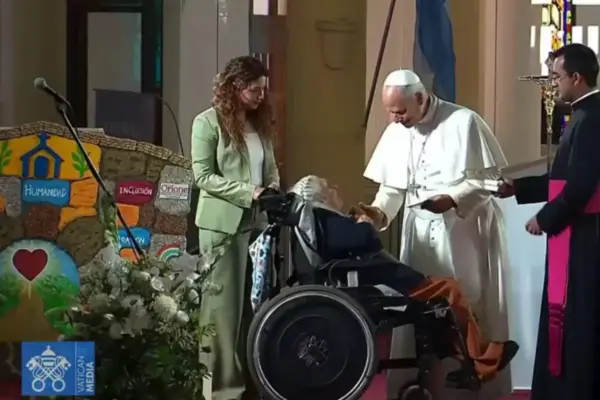









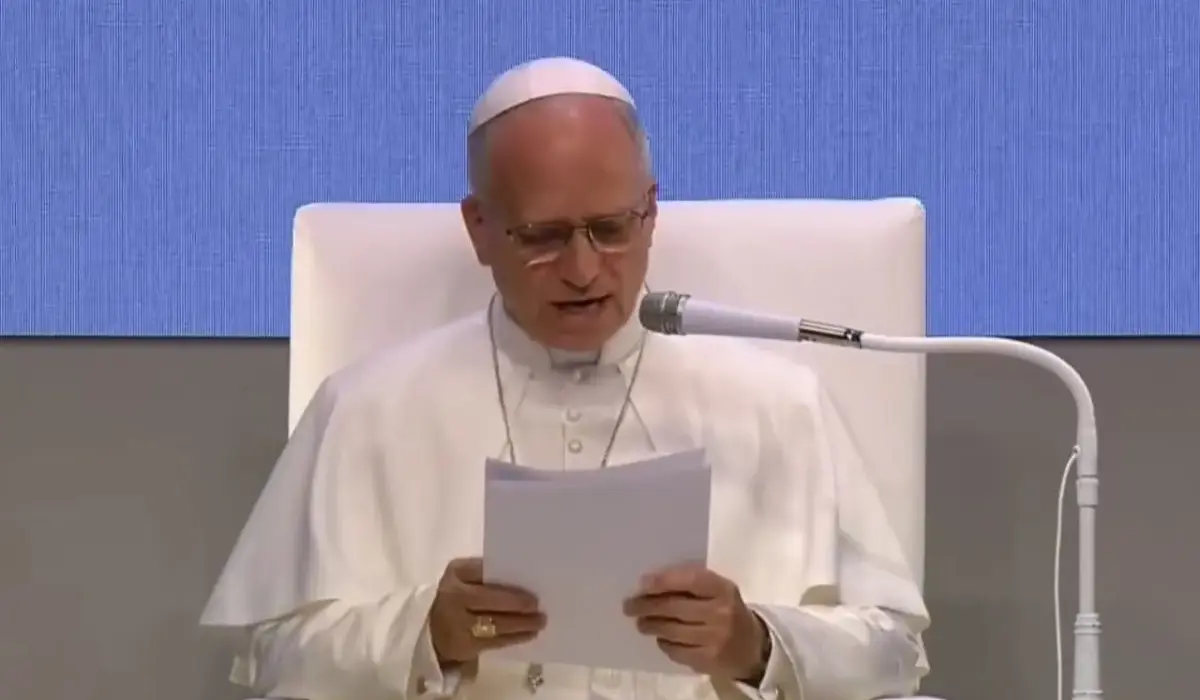
BUENOS AIRES — Continuing his high-profile Apostolic Journey through South America, Pope Leo XIV delivered a sharp and impassioned critique of economic exploitation on Monday, warning business leaders and public officials against prioritizing revenue over human dignity. Speaking during his fourth major address of the trip, the pontiff placed labor rights, social inclusion, and the ethical use of technology at the center of his message to an audience of approximately 1,000 people gathered at the Argentine Catholic University (UCA).
The private event brought together a cross-section of Argentine society, including prominent business leaders, entrepreneurs, union representatives, members of social organizations, and ordinary workers. The gathering marked a key item on the agenda for the pontiff’s second full day in the country. His visit began over the weekend with a historic arrival and a massive outdoor mass in Buenos Aires that drew an estimated 2.5 million attendees. Pope Leo is scheduled to remain in Argentina through Wednesday, maintaining a demanding schedule focused heavily on social justice, economic ethics, and community solidarity.
Monday’s address at UCA expanded deeply on themes the pope had touched upon since landing on Sunday. Surrounded by key stakeholders from both the labor and corporate sectors, the Holy Father did not shy away from addressing systemic inequalities, the ethical pitfalls of unbridled capitalism, and the pressing responsibilities incumbent upon both the state and private enterprise.
Human dignity and labor
Addressing the audience directly, Pope Leo lamented an economic reality where profit margins frequently overshadow human well-being. He cautioned that when the rule of the few dictates societal structures, labor is rapidly reduced to mere exploitation, and workers are evaluated strictly on their efficiency metrics rather than their inherent worth as human beings.
“Where the rule of the few is the law, work becomes exploitation of all those involved in the world of labor. Workers are valued solely for their efficiency,” Pope Leo said, drawing attentive silence from the diverse crowd.
The pontiff further broadened his critique to encompass environmental degradation, linking the mistreatment of workers directly to ecological harm and the neglect of future generations. True progress, he argued, cannot be measured by a system that elevates the well-being of a select few while degrading ecosystems, offloading financial and environmental costs onto the most vulnerable communities, and jeopardizing the living conditions of posterity.
Rooting his arguments firmly in the social doctrine of the Catholic Church, the Holy Father reiterated that the human person must remain at the very center of all economic and social structures.
“Human beings are the authors, the center, and the purpose of all economic and social life; therefore, the economy must be at the service of the person, and not the person at the service of the economy,” he stated, echoing sentiments he first shared upon arriving in the Argentine capital on Sunday.
The pontiff also addressed the rapid rise of automation and artificial intelligence, offering a stern reminder regarding the limits of technology in the workplace. Technology, he insisted, must always remain strictly subordinate to human ethics. Algorithms, he warned, can never serve as a valid replacement for human judgment, nor can they substitute the intrinsic value found in in-person labor and a worker’s daily effort.
The role of the state
Transitioning from corporate responsibility to the duties of governance, Pope Leo outlined a clear mandate for public authorities. He argued that governments hold the ultimate responsibility to guarantee employment, foster social inclusion, and ensure that the march of technological innovation does not leave vulnerable populations behind.
Public authorities, according to the pope, must actively promote stable, long-term policies that foster full employment. This must take place within a robust ethical framework where the economy, the free market, and the state work together in a complementary fashion to guarantee the fair and equitable redistribution of opportunities.
The pontiff stressed the vital necessity of striking an appropriate and sustainable balance between abstract economic principles, the perspective and risk-taking of business owners, and the fundamental daily needs of workers and their families.
Unemployment, the pope declared, represents a true tragedy in the lives of those who endure it. Depriving an individual of the opportunity to work extends far beyond the mere denial of a regular income; it constitutes a grave affront to human dignity, strips away a person’s capacity to actively contribute to society, and plunges them headlong into social exclusion. Such exclusion, he warned, actively fractures the cohesion of the social body and destroys vital community actions aimed at achieving the common good.
Business leaders and technology
While offering sharp critiques of corporate greed, Pope Leo also acknowledged the challenging role of entrepreneurs, celebrating the fact that many business leaders take on significant financial risks to create jobs and stimulate economic activity. However, he immediately tempered this praise with a warning that these same leaders must remain perpetually vigilant against the temptations of greed.
“Entrepreneurship is a noble endeavor if it is guided by the principle of the social function of property and capital,” the pontiff stated. He warned that when financial profit is treated as the sole benchmark of success, business operations inevitably become dehumanized, transforming into structures of sin that ultimately lead to social exclusion. True financial success, he underscored, must be measured by its contribution to the common good.
Turning his attention to institutional labor representation, Pope Leo highlighted the essential role played by trade unions and labor organizations. He described them as institutions that fight tirelessly to secure dignified conditions for workers, calling them indispensable entities necessary to defend those who lack a voice and to resist the relentless mercantilization of labor.
The Earth and its natural resources, the pope reminded the audience, were given by God for the sustenance of all humanity, not just a privileged few. Humankind, he noted, acts not as absolute owners of the planet, but rather as stewards of an inheritance that must be shared justly and equitably. This stewardship requires the active eradication of structural inequalities that marginalize the vulnerable, coupled with a deep sense of responsibility toward future generations.
Despite his warnings regarding automation, the pontiff acknowledged that technological advances hold genuine value as long as they serve humanity inclusively. He specifically praised historical and contemporary innovations created by Argentines across various fields, including astronomy, medical science, and agriculture, noting how such achievements can benefit society when properly managed.
Unions and informal workers
Pope Leo’s address was frequently punctuated by enthusiastic applause and cheers from the diverse audience at UCA. One of the moments that drew the most vocal support occurred when the pontiff acknowledged the immense value of discrete and sacrificed labor, explicitly pointing to domestic work and the grassroots social work carried out daily in impoverished neighborhoods to assist those in dire need.
He observed that social movements and informal workers do not sit back and passively wait for government assistance or charity. Instead, they organize themselves proactively to build community-based solutions from the ground up. Through their persistent calls for social inclusion, these groups consistently advocate for land, housing, and work—core requirements for genuine social justice that have frequently been emphasized by his predecessor, Pope Francis.
Concluding his address, the pontiff emphasized the vital importance of humility and collective cooperation in addressing modern societal challenges. Through the path of humility, he noted, individuals come to realize the fundamental truth that humans cannot rely solely on themselves, that they inherently need others, and that only by opening themselves up to genuine collaboration with those around them can society work together effectively to build a better world.