











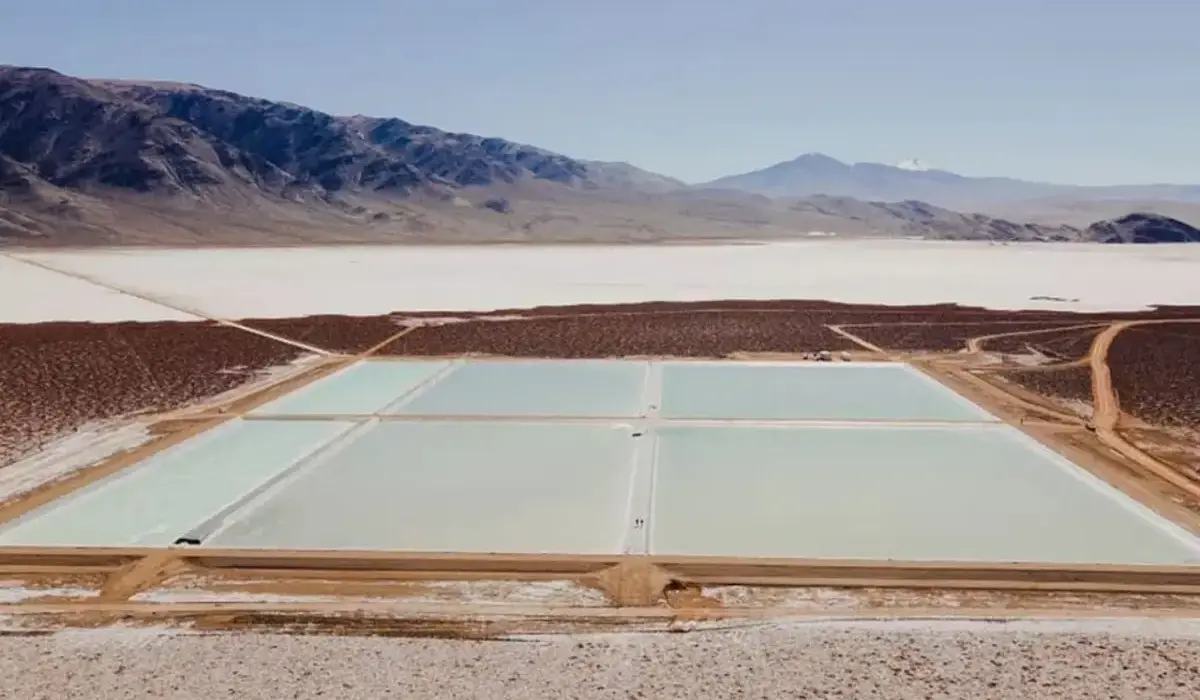
Argentina’s mining sector is experiencing a powerful resurgence, propelled by a surge in export revenues, mounting investor interest, and major regulatory shifts. As global demand for critical energy transition minerals intensifies, the country is increasingly positioning itself as a central player in South America’s extractive industries, particularly in lithium, copper, and precious metals like gold.
According to data from the national statistics institute INDEC, Argentina recorded its highest-ever mining exports in 2025, reaching a total of US$8.1 billion. This milestone marked a substantial 19.2% increase compared to the US$6.8 billion recorded the previous year.
The upward trajectory has accelerated into the current year. Official figures show that metal mining and lithium exports alone totaled US$6 billion in the first half of 2026, representing a staggering 69.7% increase over the same period in 2025.
Capital deployment is expanding in tandem with trade performance. Under the government’s flagship Large Investment Incentive Regime, known by its Spanish acronym RIGI, half of the 24 approved projects are concentrated within the mining sector, with another six currently undergoing official review.
Against this backdrop of heightened commercial and regulatory activity, Argentina, Bolivia, Chile, and Peru signed a joint declaration in late August. The agreement is designed to attract foreign investment and foster closer regional cooperation regarding critical minerals, signaling a unified front among South America’s primary resource-rich jurisdictions.
To explore the implications of this regional pact, regulatory developments, and cross-border dynamics, the Herald spoke with Francisco Balduzzi, co-chair of Womble Bond Dickinson’s Mining Practice Group. Balduzzi leads a specialized team of legal professionals providing strategic and legal counsel to global corporations navigating the complex extraction landscape.
During the interview, Balduzzi discussed what the four-nation declaration means for the continent, how regulatory alignment could shape future operations, and the evolving geopolitical landscape marked by renewed United States engagement in Latin America. While acknowledging that Argentina’s historical economic and political volatility continues to deter certain institutional investors, he emphasized that the mining sector has successfully captured substantial foreign capital, setting it apart from other domestic industries.
What was the most significant aspect of the agreement signed in August by Argentina, Bolivia, Chile and Peru?
More than a binding treaty, the August accord functions as a formal declaration of intent aimed at making regional mining operations both more predictable and operationally efficient. It is not an assertion by the four governments dictating a singular, rigid direction for their respective mining policies.
Instead, the declaration carries considerable weight because it represents a public commitment by major international producers. It brings together Chile and Peru, which dominate large-scale copper production, alongside Bolivia, Argentina, and Chile—three nations that collectively hold what are widely considered to be the world’s largest lithium reserves. From that perspective alone, its significance is substantial.

The declaration outlines four core intentions shared by the participating governments. First, it emphasizes the promotion of responsible mining practices across all four jurisdictions and the strengthening of existing supply chains. These commercial and logistical links are already established to a degree, particularly between Argentina and Chile, where a long-standing bilateral mining integration agreement is already in place.
Furthermore, the document outlines commitments to cooperate on geological research and data sharing. More importantly, it provides for the establishment of specialized technical working groups designed to address these complex cross-border issues collaboratively.
Ultimately, the agreement serves as a signal to the international market that these opportunities exist and that the governments intend to facilitate them. A joint statement issued by four sovereign nations carries genuine international political weight for foreign investors, signaling that these key jurisdictions are aligned in their strategic outlook.
Both Argentina and Bolivia are seeking investment, but Chile and Peru already have major mining industries. What do you think Chile and Peru hope to achieve with this declaration?
Established mining nations like Chile and Peru also hold a direct economic stake in neighboring resource markets through cross-border investments. Within the geography of the Lithium Triangle, particularly along the rugged border shared by Chile and Argentina, numerous mineral deposits straddle the international boundary.
In practice, physical extraction might occur on the Argentine side of the Andes, while processing, transportation, or refining infrastructure is situated on the Chilean side. This represents a tangible, physical example of regional interdependence.
Similar synergies exist or could be developed between Peru and Chile, or between Bolivia and Argentina. Natural and geographical realities dictate these connections. When a mining deposit spans a national border, operators naturally wish to avoid navigating two separate, asynchronous permitting and regulatory processes in Argentina and Chile simultaneously. The goal is to streamline and harmonize these bureaucratic timelines.
Although the recent declaration does not explicitly detail administrative mechanics, future work will likely focus on standardizing certain regulatory procedures to make binational projects practically viable for investors.
When institutional investors evaluate a project that crosses national boundaries, they view it as a single, unified enterprise. Currently, however, the legal frameworks differ markedly. Argentina operates under the RIGI framework, Peru maintains a relatively streamlined permitting system, Chile utilizes a mixed corporate model involving state and private actors, and Bolivia is gradually opening its doors to foreign capital.
Bringing these legal frameworks to a more comparable level of efficiency would make regional investment significantly more attractive. Additionally, supply chain integration plays a crucial role. Because Peru and Chile possess mature, established mining sectors, they naturally host a deeper pool of specialized industrial service providers than Argentina and Bolivia. This integration could facilitate the expansion of those service networks across borders, generating broad economic benefits.

At the same time, this diplomatic declaration alone will not automatically unlock capital flows. Attracting long-term capital requires demonstrating enduring macroeconomic and regulatory stability. Mining projects demand multi-decade commitments; while corporations occasionally deploy capital into unstable environments, stability invariably enhances a project’s viability. Investors must also signal their confidence through active participation on the ground.
Crucially, this development is not exclusively about courting foreign capital. It is equally about fostering domestic industrial growth and ensuring that regional companies—such as an Argentine firm seeking to expand operations into Chile—can clearly understand and navigate local legal frameworks.
Beyond the RIGI and this joint declaration, what would it take to trigger investment in Argentina?
That is the million-dollar question. Working within the energy and natural resources sector, I have consistently observed that mining attracts a higher volume of foreign investors than other extractive industries in Argentina.
While investment is beginning to return, the historical context must be acknowledged. During the 1990s, Argentina established an inviting framework for foreign capital. Over the subsequent two decades, however—with the notable exception of the administration led by Mauricio Macri—the country experienced repeated policy reversals, including asset expropriations and strict controls on the repatriation of dividends.
Consequently, foreign investors generally fall into two distinct camps. The first group comprises those who suffered financial losses during past interventions and remain entirely unwilling to consider reinvestment until a prolonged period of institutional stability is definitively established. For these market actors, trust is closely tied to the political durability and continuity of the current administration.
In their view, they are dealing with a sovereign borrower that has repeatedly altered the rules of the game. Having met with many of these executives, I can confirm they currently want nothing to do with the domestic market.
The second group consists of investors who view the current geopolitical alignment—particularly increased engagement from the United States government across Latin America—as a novel and positive development. Washington has adopted a more supportive posture toward South America than has been observed in many years, prompting this segment of the investor community to deploy capital into the region.
When comparing Argentina’s petroleum sector to its mining industry, foreign capital is visibly more active in mining. Nevertheless, Argentina faces a structural disadvantage stemming from years of unpredictable governance. Rebuilding international trust requires more than simply passing new laws; once enacted, those regulations must be consistently enforced and respected over an extended period.
A notable shift occurred following the announcement of a currency swap arrangement with the United States. Inquiries directed to our offices accelerated immediately, as tangible backing from Washington sent a powerful signal to the global market.

Early investments tend to generate a catalytic effect, drawing in secondary participants who might otherwise remain hesitant. That is the operational reality of global capital markets.
Meanwhile, market fundamentals are shifting. The initial lithium boom experienced rapid expansion followed by a period of price stabilization, while copper faced acute structural supply deficits even before the acceleration of the global energy transition and renewable infrastructure development.
Global demand for copper remains immense. While Chile and Peru are established leaders in copper production, Argentina holds immense geological potential to become a major supplier.
If Argentina successfully achieves macroeconomic stability and the United States maintains its current supportive diplomatic and economic policy, the entire region stands to benefit significantly. Success depends on a combination of factors, extending well beyond domestic policy alone.
Ultimately, capital deployment remains competitive. Argentina can implement flawless domestic policies, but if an alternative jurisdiction boasts superior mineral geology, mining houses will inevitably direct their capital toward those richer deposits. Even so, within Argentina’s broader natural resource economy, mining has captured the highest level of sustained international interest.
Do you think investors’ perception of Argentina as a country without legal certainty could change in the coming years?
Shifting the broader international perception of Argentina as a volatile investment destination will undoubtedly take considerable time. Within the mining sector, however, that rehabilitation process is already underway. As successful capital deployments accumulate on the ground, additional investment is likely to follow.
The formalization of binational integration agreements, particularly with Chile, provides a decisive strategic advantage for project developers. If these cooperative initiatives successfully translate from diplomatic declarations into operational realities, extraction projects can be executed with far greater administrative and regulatory efficiency.
Could Argentina become a mining country like Chile and Peru in the coming years?
Argentina undeniably possesses enormous geological potential, but Chile and Peru benefit from decades of continuous history and institutional maturity dedicated exclusively to mining development.
Furthermore, Argentina’s economic identity is uniquely diversified. Unlike its Andean neighbors, where mining constitutes the absolute cornerstone of the national economy, Argentina remains rich across multiple distinct sectors, balancing resource extraction with expansive agricultural, industrial, and energy capabilities.