

Families come in all shapes and sizes, yet children do not always get to see those diverse realities reflected on screen. The upcoming animated feature film The Cat in the Hat offers a refreshing and long-overdue example of this by placing a Latine family at the very center of a universally familiar story. Instead of relying on tropes, the movie focuses on a relatable household navigating life’s major transitions together and learning to appreciate where they are in the present moment.
Slated to hit U.S. theaters on November 6, 2026, the film reimagines the classic Dr. Seuss children’s book as an expansive, whimsical adventure about change and belonging. At the heart of the narrative is Carmen, a hardworking Latina single mother employed at a hospital while diligently raising her two children, Gabby and Sebastian. When the family packs up and moves to a brand-new town, the siblings naturally struggle to adjust to their unfamiliar surroundings, new schools, and altered routine.
That is when the iconic Cat enters the picture. Brought to life by voice actor Bill Hader, the latest iteration of the mischievous feline works for the fantastical Institute for the Institution of Imagination and Inspiration. His primary assignment in this cinematic adaptation is to cheer up the stressed-out siblings, bringing joy, chaos, and boundless imagination to children who need it most.
What makes Carmen’s role particularly notable in the landscape of family animation is how her identity as a single mother is handled. Her family structure is never treated as a defining characteristic, a dramatic plot device, or a problem that needs fixing. She is simply depicted as a dedicated mother doing the everyday work of raising her kids. For acclaimed actress America Ferrera, who voices Carmen, seeing families like hers represented on screen in such a natural, positive, and unremarkable way feels deeply personal.
Ferrera’s connection to the role stems directly from her own upbringing. Growing up as the youngest of six children raised entirely by a single mother, the actress remembers the powerful psychological impact of the narrow media representation prevalent during her childhood.
"I was raised by a single mom. I’m the youngest of six kids, and it was just my mom raising us," Ferrera reflects, looking back on her early years. "I remember growing up with this image of the perfect family on TV, which is a mom and a dad, a boy and a girl, and a dog. And that’s what a family looks like—so I think it really hit something deep for me."
She reflects at length on how growing up seeing only one rigid version of a family shaped what she and her peers believed a household was allowed to look like. The media messaging of her youth created an unspoken standard that made alternative family setups feel inherently flawed.
"I remember growing up and feeling like that was the right way to be a family and every other way of being a family was kind of messy or wrong or faulty," Ferrera says. "And I think it’s so beautiful that kids can grow up seeing that families look like all different kinds of things and that the love is real and family is family. I was raised by a single mom, and I just think that they’re superheroes holding everything together, and Carmen is definitely a superhero."
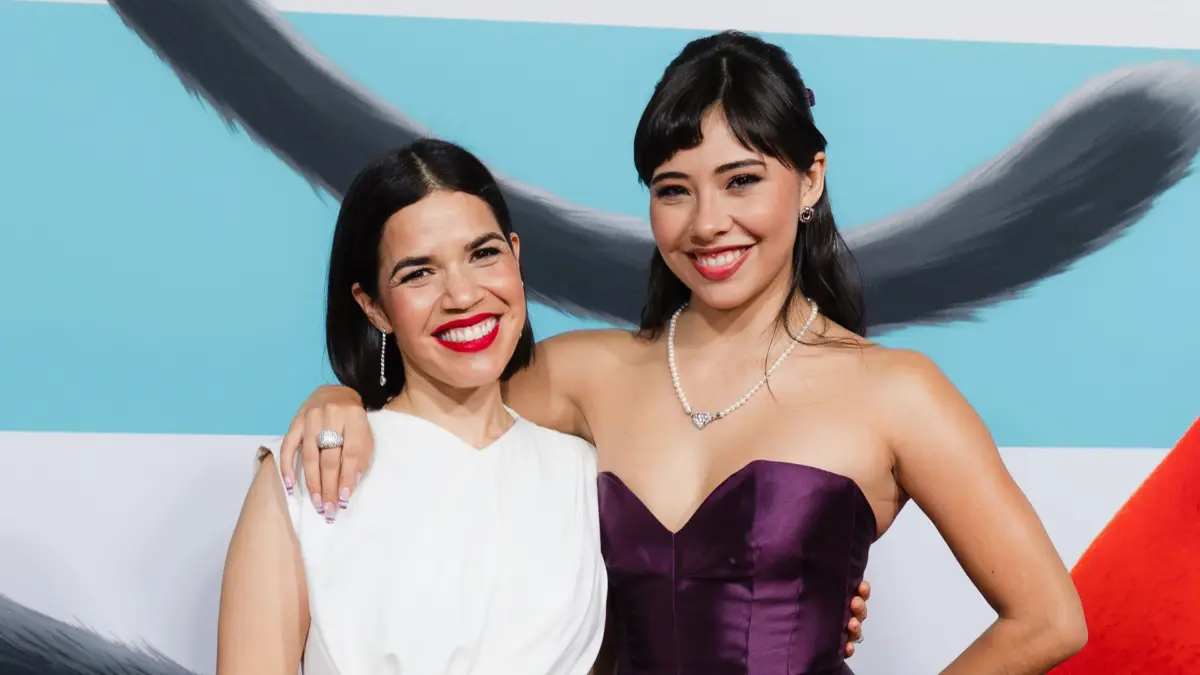
Xochitl Gomez, who voices Gabby and joined Ferrera for the film’s early press junket, echoed these sentiments wholeheartedly, emphasizing just how meaningful this style of quiet, everyday representation truly is for young audiences.
"Just to add on to that, I think when you see something on screen, and it’s so normalized, it makes it feel okay," Gomez explains. "And that’s something that I love about film, is that when you see something represented on screen it doesn’t seem odd or alarming or scary because it is what it is. And the way it’s so natural in this movie is perfect."
Over the past decade, major animated films have increasingly featured Latine families, most notably in critically acclaimed projects like Disney’s Coco and Encanto. However, those stories largely centered their entire plots around cultural identity, traditions, and folklore. The Cat in the Hat offers something different and distinctly valuable: a Latine family simply existing within a mainstream, familiar story, without their cultural background having to drive the narrative arc. It represents the kind of casual, everyday visibility that remains rare in children’s animation, marking an encouraging step toward making such inclusive casting standard practice.
Ferrera notes that Dr. Seuss’s original creation is an ideal vehicle for this kind of universal storytelling because the character himself transcends human demographics.
"The Cat in the Hat is so iconic. It’s part of our childhoods. It was part of mine. It’s part of my kids. I read it to them. I read all of Dr. Seuss to them," Ferrera says. "So, the idea that we can, as we should, be present inside of all the stories—it’s all imagination. The Cat in the Hat is not a color. He’s not a race. He’s a cat. So, we all belong there. We all belong inside of these big stories that particularly help kids imagine what’s possible in the world."
Ferrera adds that she strongly hopes this style of casting and character development becomes fully normalized for an emerging generation of children of color, ensuring they see themselves reflected in the cultural touchstones of their youth without it feeling like a deliberate statement.
"That it’s normal for them to go to the movie theater and that the biggest, most iconic stories being told in their time reflect them to them," she says. "That shouldn’t be weird. That should be normal."
Reflecting on the collaborative process behind the animated project, Gomez shared that getting to work on the same film as Ferrera deepened her appreciation for the production, even though their recording schedules did not overlap.
"The saddest part is I didn’t actually get to record with her, but I’ve known her for a minute, and so getting to see her in her real job format instead of at an event format is really fun," Gomez says, expressing clear admiration for her co-star.
Looking directly at Ferrera during a joint discussion, Gomez added, "I admire how good you are at this. You come prepared, and I like that because a lot of people don’t. It makes me feel like I’m on the right path."
Ferrera brings a wealth of experience to the project, having previously voiced characters in several notable animated films, including the How to Train Your Dragon franchise, Disney’s Tinker Bell, and Arco. Having spent years in recording booths bringing animated characters to life, she has developed a profound appreciation for the medium and a keen awareness of the lasting psychological footprint these movies leave on young viewers.
"I just think that there’s something about animated movies that hold such a special place in people’s lives, particularly kids," she observes. "When you’re young, and you fall in love with something, it’s like you never love anything as much as you love the things that you love when you’re a kid."
She emphasizes that she hopes young viewers walk away from The Cat in the Hat understanding a few fundamental truths: that families do not all look identical, that it is completely normal and acceptable for families to experience periods of struggle, and that being different or a little bit eccentric is something to celebrate rather than hide.
"I know that in five years, 10 years, 15 years, we will be hearing from the kids who grew up watching this movie saying, ‘That movie meant this to me,’" Ferrera concludes. "And that’s always my favorite part of being a part of a film like this."