











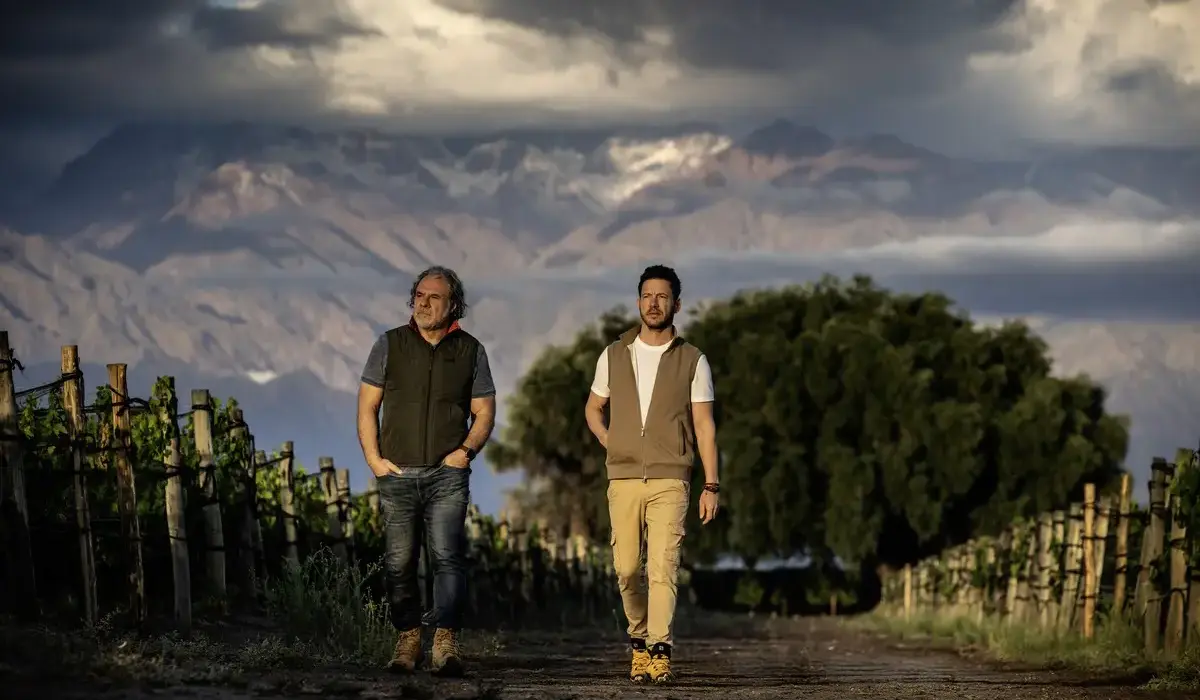
Back in 2009, renowned winemaker Marcelo Pelleriti established a modest, artisanal venture in the high-altitude landscapes of the Uco Valley in Mendoza, concentrating his efforts on carefully selected vineyard plots. What began as a small-scale passion project rooted in meticulous viticulture has now blossomed into a formidable international enterprise. Today, Pelleriti is aiming significantly higher, setting his sights on cementing the region’s status as a premier global wine destination.
Following more than a decade of dedicated soil studies and a steadfast commitment to minimal-intervention winemaking, Pelleriti has once again joined forces with fellow vintner Miguel Priore. Together, they have built Pelleriti-Priore, a brand that now exports an impressive 40,000 cases of wine worldwide. Along the way, the partnership has garnered critical acclaim, securing prestigious international ratings of up to 97 points from esteemed wine critic James Suckling.
Stretching along the banks of the Tunuyán River, the Valle de Uco stands as one of the most prominent and dynamic wine-growing regions situated south of Mendoza city in western Argentina. The area benefits from a unique confluence of geographical and climatic factors. High elevations, mineral-rich alluvial soils, and vital irrigation sourced directly from the snowmelt of the Andes Mountains create an exceptional environment for viticulture. Furthermore, the region experiences a long growing season boasting more than 250 days of sunshine annually, minimal rainfall, and vast temperature swings between warm days and cool nights. These dramatic diurnal shifts provide the ideal conditions for wine grapes to develop complex flavors while retaining essential acidity.
While the Uco Valley is internationally celebrated above all for its stellar Malbec red wines, the region’s agricultural landscape is rich and diverse. Traditionally, local producers have cultivated Semillón and Malbec, alongside smaller, complementary quantities of Bonarda and Barbera. In more recently established vineyards, modern vine growers have increasingly favored mid-ripening varieties, such as Merlot and Pinot Noir, which find optimal ripening conditions in this specific terroir. Meanwhile, classic heavyweights like Cabernet Sauvignon and Chardonnay thrive in the lower elevations of the region, and regional Syrah has earned a reputation for being exceptionally high in quality.
A Rock Star of the Cellar
Marcelo Pelleriti’s journey into the world of wine is deeply personal. He grew up making wines alongside his grandfather, absorbing generational knowledge before crafting his very first commercial batch in 1994 at a friend’s estate. His professional education extended far beyond Argentina; he spent 22 years working in the legendary Pomerol region on Bordeaux’s Right Bank. During this formative period, he was mentored by the celebrated French Bordeaux-based oenologist Michel Rolland. Both Pelleriti and Rolland played critical, pioneering roles in elevating Argentine Malbec from a regional secret to a powerhouse of global prominence.
During his long tenure at Bodega Monteviejo in the 2010s, Pelleriti began a unique tradition of celebrating each year’s harvest with a grand asado—a traditional Argentine barbecue—accompanied by live rock concerts. An accomplished guitar player himself, Pelleriti naturally befriended many of Argentina’s most prominent rock musicians. Over time, these friendships evolved into creative collaborations, with several musicians partnering with him to launch dedicated wine labels. The annual celebration eventually expanded into the massive Wine Rock festival, drawing crowds of up to 3,000 enthusiasts who gathered to celebrate the intersection of great music and fine wine.
In those vibrant days, Pelleriti frequently made headlines not just for his winemaking prowess, but for the notable artists associated with his collaborative projects, including Juanchi Baleirón, Pedro Aznar, Fernando Ruiz Díaz, and Coti Sorokin.
Reflecting on that colorful era, Pelleriti shared his perspective with the Herald. "It was a very beautiful stage of my life, but now I’m completely focused on this project," he explained. "Rock is important for me, and I still play, but I learned to separate my professional and business life from my musical passion, rather than mixing the two. Business is business. Passion is passion."
From Uco Valley to the World
Pelleriti’s overarching goal for this next chapter is clear: to achieve sweeping international recognition and help transform the Valle de Uco into the undisputed Grand Cru of the New World.
"Today, Valle de Uco has a similar reputation to areas like Napa Valley or Burgundy. Having Valle de Uco on the label is a major selling point," Pelleriti noted.
This pursuit of focused excellence is reflected in a dramatic streamlining of his portfolio. While he previously managed as many as 150 different labels, he has consciously reduced his production to just seven carefully curated expressions. This refined lineup includes his flagship MP Signature line, featuring Malbec and Cabernet Franc, alongside a series of prestigious cult labels: the 1853 Old Vine Estate Selected Parcel Malbec, Terroir Expressions Hostage Altamira Single Vineyard Malbec, 1853 Old Vine Estate Grand Reserve Heritage Malbec, and the Pelleriti Blend of Terroir. At the very pinnacle of his production sits his top-of-the-line Supremo Malbec.
Supremo represents the ultimate culmination of Pelleriti’s decades of experience, designed explicitly to position Argentina at the forefront of great New World terroirs. The wine is an intricate creation, blending three distinct vintages together with a rigorous selection from specific micro-parcels, which are subsequently subjected to dedicated micro-vinifications.
"All in pursuit of excellence," Pelleriti says of the painstaking process.
Since formally launching the Pelleriti-Priore venture in 2023, the brand has operated with a distinct market strategy, selling exclusively to specialized retailers, independent wineries, and fine-dining restaurants. The vast majority of their production—some 80%—is allocated to the United States market. The remaining volume finds its way to discerning consumers in the United Kingdom, Brazil, Denmark, and select markets across Asia and Latin America.
Up to this point, these high-end bottles have maintained a remarkably low profile on domestic supermarket shelves within Argentina. Aside from the accessible Signature label, nearly the entire production was earmarked exclusively for overseas buyers, creating a strict division between the brand’s international portfolio and its domestic presence.
That dynamic, however, is beginning to shift. "Now we’re in major stores and venues where people can actually find the brand," Pelleriti observes.
When asked to categorize this pivotal juncture in his professional life—hesitating between whether to define it as a launch, a relaunch, or a comeback—Pelleriti considers the question carefully before offering his verdict.
"A little bit of all three," he concludes. "But I would like to call it a new beginning."