









“Para bailar La Bamba se necesita una poca de gracia.”
There is a strong chance you have heard these famous opening lines on the radio, on television, while walking through the grocery store, or at a festive family gathering at least once in your life. While the infectious rhythm of "La Bamba" has been recorded and performed in various styles over the decades, one of the most definitive and historically significant versions was captured by Ritchie Valens. Though his time in the public eye was tragically brief, this rock ’n’ roll icon left an indelible mark on American music that continues to resonate more than half a century later.
During Hispanic Heritage Month, Salud America! joins communities across the nation in celebrating Latino trailblazers, pivotal historical figures, and inspirational stories that have shaped the cultural fabric of the United States. This year, the spotlight shines brightly on the remarkable career and enduring contributions of Ritchie Valens, a pioneering Mexican American singer and songwriter who broke barriers and blazed a transformative trail for generations of rock musicians to come.
Ritchie Valens: Early Life Before Fame
Long before he was a household name, Richard Steven Valenzuela was born on May 13, 1941, in Pacoima, California, a working-class neighborhood in the northern San Fernando Valley. Growing up in a culturally rich environment, he developed a deep and abiding passion for music at a remarkably young age. Encouraged by his family, who recognized his natural affinity for melody and rhythm, he picked up the guitar and began teaching himself how to play.
The young musician faced an immediate and unusual hurdle in his development. Although he was naturally left-handed, standard instruments were rarely built for left-handed players in stores of that era. Driven by an intense eagerness to learn and play, he adapted by mastering the more readily available right-handed version of the instrument. This early determination became a hallmark of his approach to both music and life.
By the time he reached the age of 16, Valens’s talent had progressed to the point where he joined his first local band, the Silhouettes. The young performers played wherever they could find an audience, taking on local gigs, school dances, and community events throughout the San Fernando Valley. It was during one of these energetic local performances that Valens was discovered by Bob Keane, a prominent record producer and founder of the independent Del-Fi record label. Signing with Del-Fi marked the official beginning of Valens’s professional journey into the heart of the American music industry.
Valens drew his artistic inspiration from a remarkably diverse array of musical sources. According to biographical accounts, his sound was a unique synthesis of traditional Mexican folk music he heard growing up, popular rhythm and blues (R&B) acts of the day, and the raw, innovative energy of pioneering rock performers like Little Richard. This eclectic background equipped him with a distinct sonic palette that set him apart from many of his contemporaries on the 1950s pop scene.
Ritchie Valens: Finding Success in Music
As he prepared to enter the mainstream recording studio, Bob Keane suggested that the young artist shorten his surname from Valenzuela to Valens, believing it would sound more contemporary and "radio-friendly" for commercial audiences. Valens embraced the change and quickly proved his commercial viability with his very first single released through Del-Fi records, the high-energy track "Come On, Let’s Go."

The promising young singer achieved even greater commercial and cultural triumphs in 1958 with a pair of landmark hit songs that solidified his status as a national pop star. First came "Donna," a tender, heartfelt ballad written for a high school sweetheart that resonated deeply with teenage audiences across the country and ultimately soared to the number two position on the national pop charts. Shortly thereafter, he released "La Bamba," a daring and revolutionary rock ’n’ roll cover of a traditional Mexican folk song from the state of Veracruz.
Music historians and cultural analysts have long noted the groundbreaking nature of that recording. As noted by educational and cultural organizations like Teach Rock, "La Bamba was a revolutionary song that fused elements of a traditional Mexican folk tune with rock and roll," effectively bridging two distinct cultural worlds and proving that Spanish-language rhythms could captivate mainstream American listeners.
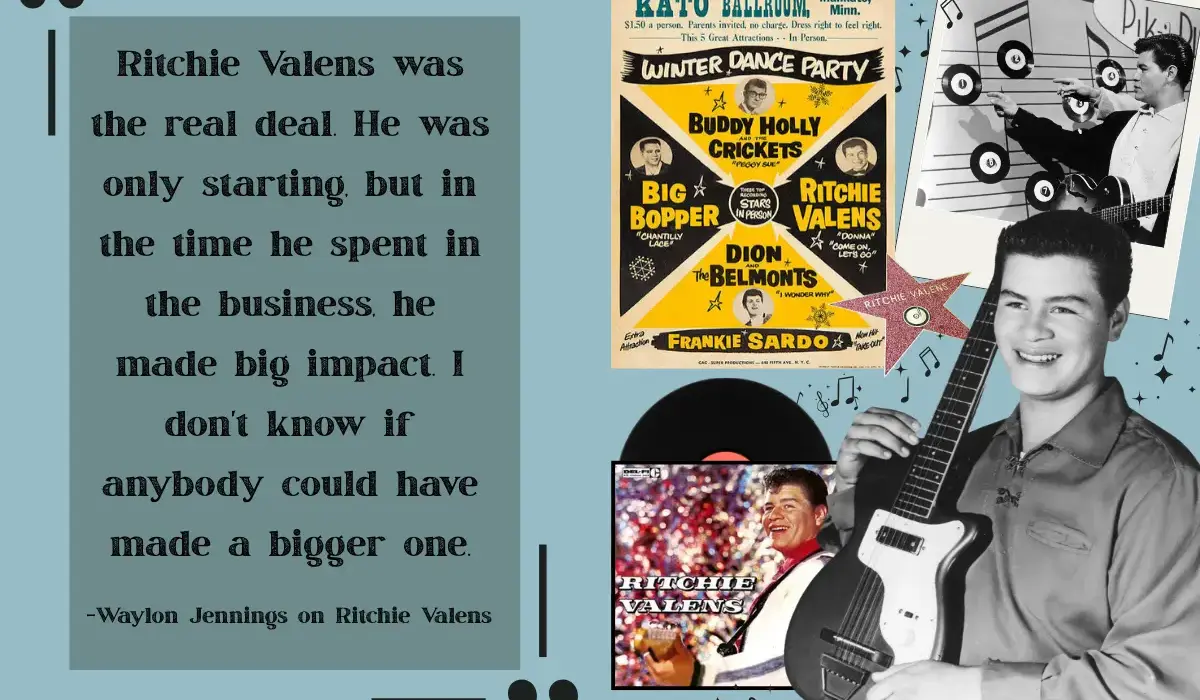
As his popularity surged, Valens expanded his presence beyond the airwaves and record players, making high-profile television appearances on programs such as American Bandstand and The Perry Como TV Show. He also transitioned to the silver screen, securing a memorable musical role in the teen rock film Go, Johnny, Go!. Eager to build on his momentum and connect directly with fans across the country, Valens signed on to join the ill-fated Winter Dance Party Tour in January 1959. He hit the road alongside other rising and established rock stars of the era, including Buddy Holly, Dion and the Belmonts, and J.P. "The Big Bopper" Richardson.
Ritchie Valens: The Day the Music Died
The grueling winter tour brought the performers to Clear Lake, Iowa, for a concert on the evening of February 2, 1959. Following the energetic show, the exhausted musicians needed to travel through freezing Midwestern winter weather to reach their next scheduled stop in Minnesota.
Frustrated by the wretched condition of their tour buses—which lacked operational heaters and frequently broke down while navigating treacherous snowy roads—headliner Buddy Holly made the executive decision to charter a small local airplane. The aircraft was meant to transport him and a couple of bandmates ahead to Fargo, North Dakota, allowing them vital time to rest, do laundry, and prepare for the upcoming performance. The small Beechcraft Bonanza aircraft had limited seating capacity, accommodating only the pilot, Holly, and two passengers.
According to historical accounts and biographical documentation, a fateful series of events determined who boarded the flight. Valens managed to secure a seat on the small plane by winning a coin toss against Buddy Holly’s young guitarist, Tommy Allsup. Simultaneously, J.P. Richardson, who was suffering from a severe case of the flu, successfully asked to trade places with another original passenger, Waylon Jennings, so that he could have a more comfortable journey.
The small aircraft taxied down the runway and took off into the dark, snowy, and severely overcast early morning hours of February 3, 1959. It would remain airborne for only a matter of miles. The plane encountered severe weather conditions shortly after departure and crashed into a snowy cornfield just outside Clear Lake, instantly taking the lives of Valens, Holly, Richardson, and the young pilot.
Later investigations and historical records revealed that the pilot, though possessing four years of flying experience, was only 21 years old and lacked the specialized instrument ratings required to navigate safely through heavy blinding snow and zero-visibility conditions. Furthermore, he was unaware of a critical severe weather advisory that had been issued shortly before takeoff.

The sudden and catastrophic news of the crash, which claimed the lives of so many young talents—including Ritchie Valens at the tender age of just 17—sent profound shockwaves of grief across the United States. Despite his extremely short time in the spotlight, Valens left behind a catalog of vibrant recordings. His self-titled debut studio album was released by Del-Fi records shortly after the tragic accident and performed admirably on the national charts, keeping his voice alive for a devastated public. The poignant tragedy would later be permanently etched into American folklore and popular culture, most notably immortalized by Don McLean in his iconic 1971 epic song, American Pie.
Ritchie Valens: Lasting Impact
Though his professional career lasted a mere eight months, Ritchie Valens’s name, image, and musical contributions remain deeply beloved, respected, and recognized across the globe today. His extraordinary life, meteoric rise to fame, and heartbreakingly sudden end were immortalized on the big screen in the 1987 biographical film La Bamba, written and directed by Luis Valdez and starring Lou Diamond Phillips as Valens alongside Esai Morales.
On the surface, La Bamba serves as a straightforward biographical narrative chronicling Ritchie’s meteoric rise from the San Fernando Valley to national stardom. However, the critically acclaimed film delves much deeper, exploring universal themes centered on the vital importance of family, the deep emotional resonance of music, and the systemic social barriers and discrimination that Latinos routinely faced in 1950s America. The movie did more than simply reintroduce Valens’s music to younger generations; it emerged as a powerful cultural milestone and a source of profound pride for many Latino communities.
Cultural institutions, such as the Criterion Collection, have noted the film’s broader societal significance, observing that in telling Ritchie Valens’s story through a major mainstream cinematic lens, the production created an enduring pathway for authentic representations of Chicano life to be welcomed not only into popular culture, but rightfully viewed as an integral part of broader American culture.
Today, music historians, fans, and fellow artists widely regard Valens as a true founding father of Chicano rock. His trailblazing efforts were formally recognized by the wider entertainment industry decades after his passing. In 1990, Valens was honored as the first Latino rock artist to receive a star on the Hollywood Walk of Fame. Over a decade later, in 2001, he was posthumously inducted into the prestigious Rock and Roll Hall of Fame, cementing his permanent place in music history.
Finding mainstream commercial success at a historical juncture when very few Latino voices were heard in mainstream American rock and pop music, Ritchie Valens shattered glass ceilings and cleared a path for countless musicians who followed in his footsteps. His pioneering spirit continues to echo through the work of legendary acts such as Los Lobos, Los Lonely Boys, Carlos Santana, and generations of contemporary artists who trace their artistic roots back to the young man from Pacoima who picked up a right-handed guitar and changed the sound of American music forever.