








In the bustling landscape of Chicago’s contemporary dining scene, few restaurateurs have made as prolific and multifaceted a mark as Zubair Mohajir. Known for his creative vision behind concepts such as Lilac Tiger, Mariela, Mirra, Sarima, and Coach House, Mohajir has spent years shaping the city’s palate through diverse culinary lenses. Yet, it is his latest venture, Muhājir, that stands apart as the truest reflection of his personal history, ancestry, and lifelong culinary philosophy.
The restaurant anchors a yearlong editorial series celebrating some of the most exciting new dining destinations across the United States. Through behind-the-scenes reporting, industry reflections, and exclusive culinary events—including upcoming dinners hosted as part of Dinner Party, presented by Capital One—food enthusiasts are given a rare glimpse into the complex reality of launching a buzzy new restaurant in major metropolitan hubs like Chicago, New York City, and Washington, D.C. At Muhājir, the narrative is not merely about launching a successful venue; it is an ambitious exploration of global migration, historical trade routes, and ancestral identity told entirely through the medium of live-fire cooking.
What did you want to explore with Muhājir that you hadn’t been able to do yet with your previous restaurants?
For Mohajir, the restaurant’s namesake is deeply personal. The word “muhājir,” rooted in both Arabic and Urdu, translates directly to “one who migrates.” Historically, the term carries heavy historical weight, famously used to describe the Muslims who relocated from India to Pakistan during the partition of 1947. Growing up with this surname, Mohajir often wondered about the origins of his family name, a question that gained profound clarity when he transitioned into a professional cooking career after initially working in finance.
His late maternal grandfather dedicated significant effort to mapping the genealogy of the family name, eventually tracing it back to Southern Basra in Iraq—a critical geographic hub along ancient global spice routes. This discovery served as a revelation for the chef, who had already spent five years at Coach House exploring pre-Crusade culinary intersections of Muslim, Christian, and Jewish influences across southern Spain and Portugal. These historical recipes were fundamentally shaped by Southeast Asian traders traversing Mediterranean networks that stretched toward North Africa and the Iberian Peninsula.
Driven by an enduring fascination with history, Mohajir sought to feed people while offering explicit context about the origins of the ingredients on their plates. At Muhājir, the culinary roadmap follows the ancient spice road running from Portugal through the Mediterranean and the Levant, winding out of Basra into the Persian Gulf, and ultimately landing on the shores of southern India, where Mohajir’s own family roots lie. In Mohajir’s view, the overarching theme of the restaurant transcends his personal lineage, reflecting a universal truth: humanity is defined by movement, and all of our families ultimately originated somewhere else.

Why did you decide to build the restaurant around live fire?
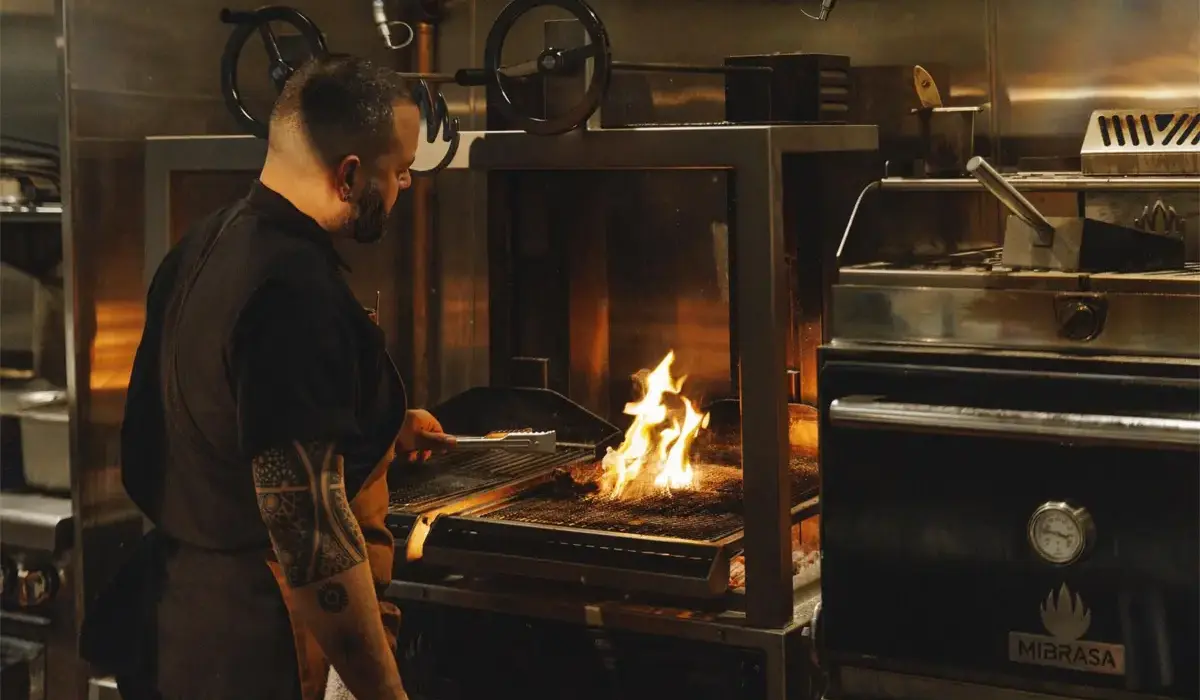
Despite his extensive background in professional kitchens, Mohajir had never previously cooked over live fire. However, conceptualizing Muhājir required returning to fundamental, primal techniques rather than relying on standard commercial kitchen setups.
The decision was heavily inspired by memories of his grandmother’s home in India, where modern gas stoves were absent, and cooking was inextricably linked to the elemental warmth and smoke of burning wood. When he committed to bringing the Muhājir concept to life, it became immediately apparent that the historical narrative of global migration and ancient spice routes could not be authentically conveyed using a standard sauté pan on an electric or gas range. To tell the story right, the kitchen demanded the raw, tactile nature of wood fire.
Is there a dish that feels especially representative of Muhājir?
The commitment to historical narrative and live-fire technique culminates in some of the restaurant’s most ambitious menu items, most notably a duck experience inspired by a meticulously researched 927-year-old recipe from southern Spain. This historical dish bridges Roman garums with overlapping Muslim and Jewish culinary traditions.
The preparation is a multi-step craft. The restaurant begins with a whole duck, which is butchered in-house, leaving the crown to dry-age for a full seven days. The wings are utilized to build a rich, deeply concentrated jus, while the legs are transformed into a tender confit. When daily service begins, the duck crown is blasted over the open fire before being finished in the brasa. Diners seated in the dining room can watch the ducks hanging directly over the live flames.
When the dish is brought to the table, it is presented on an ornate Turkish platter accompanied by black raspberry achaar, a saucier of duck jus, savory duck rice, and crisp medallions of duck skin resembling duck chicharrón. The centerpiece is the duck breast itself, boasting a shatteringly crisp skin seasoned with the authentic 900-year-old spice blend. Featuring cumin, coriander, cardamom, toasted pine nuts, red wine vinegar, and fish sauce, the dish serves as a tangible monument to historical cross-cultural collaboration.
You have a bar called Bobo behind the restaurant. How do the two spaces complement each other?
The immersive experience of Muhājir extends beyond the main dining room into Bobo, an intimate bar located directly behind the restaurant. Bobo was developed in partnership with Jacob Dela Cruz, a close collaborator with whom Mohajir previously built Sarima. It was Dela Cruz who originally suggested the name Muhājir, offering the profound observation that everyone is an immigrant.

The naming of Bobo carries its own affectionate backstory. Dela Cruz’s father is named Bho, and while “bobo” translates in Tagalog to terms meaning “silly” or “stupid,” it is used here as a term of endearment. The concept behind the bar reflects a foundational philosophy: despite the intense historical weight and transformative nature of the food served at Muhājir, the team believes strongly in maintaining a sense of playfulness and fun.
Operationally, the two spaces function in tandem. Guests arriving early for their reservations are welcomed into Bobo, and diners frequently stop by the bar for a nightcap following their meal. Because accessing Bobo requires walking through the main restaurant, the physical layout encourages natural curiosity. Visitors to the bar often find themselves eager to book a table for dinner, while diners enjoying Muhājir frequently look toward the back and wonder about the energetic activity happening beyond the threshold.
What has it been like to run Muhājir so far?
Reflecting on the realities of managing a high-profile opening, Mohajir notes that while the challenges have not necessarily diminished, his approach to problem-solving has evolved. Over years of operating multiple establishments, he has cultivated a methodical framework for addressing operational hurdles directly, working collaboratively with his team and supporters. Notably, Muhājir operates without backing from private equity firms, relying instead on its guests as financial stakeholders. Navigating expectations and overcoming obstacles, he notes, becomes smoother through repetition.
For Mohajir, Muhājir represents the realization of a long-held career aspiration. While previous restaurant projects involved building concepts where he was often removed from the day-to-day operations of the line—such as leaving Mirra’s kitchen to be run by chef Rishi Kumar—Muhājir offers the hands-on environment he has worked toward his entire life. Describing it as a long-sought professional home where he envisions growing old, the chef acknowledges that amidst the wild and demanding nature of a new opening, he finds himself increasingly able to pause, settle into the present moment, and recognize that he has finally arrived where he belongs.