








Addressing industry leaders, policymakers, and international investors gathered at the prominent regional exhibition, Milei announced that monthly exports from the sector had shattered previous records, exceeding US$10 billion. He directly attributed this dramatic expansion to the structural reforms, market liberalization policies, and legal guarantees implemented since he took office.
"For a decade, Vaca Muerta operated at half capacity, with artificially suppressed prices, currency controls, and fear of investing. When we changed the rules, in less than three years we started exporting like never before," Milei told the audience, referring to the massive and prolific shale formation located primarily in the Neuquén Basin.
The president argued that possession of abundant natural resources alone could never guarantee true national prosperity without the foundational support of sound economic institutions that actively encourage private investment and rigorously protect private property rights. He emphasized that the physical geography of the region had remained constant, while the regulatory philosophy governing it was what fundamentally transformed.
"What changed? Did oil magically encourage itself? No, the formation was always there. What changed were the rules," he added, framing the government’s free-market approach as the catalyst for unlocking decades of dormant economic potential.
Oil Production Nears One Million Barrels a Day
During his address, Milei detailed the explosive growth trajectory of the Vaca Muerta shale formation, presenting data that showed average production rising from approximately 310,000 barrels per day in 2023 to more than 670,000 barrels per day by August 2026. This localized surge has propelled national oil production to an impressive 932,000 barrels per day in August, a steep increase from the roughly 635,000 barrels per day recorded in 2023. This milestone successfully surpasses the previous historical production record established back in 1998, a watershed moment for Argentina’s heavy industry.
"For the first time in history, we are just a few steps away from one million barrels a day," Milei stated, underscoring the rapid industrial momentum building across the region.
International shipments have mirrored this domestic production boom. Oil exports have more than doubled from an average of 128,000 barrels per day in 2023 to double that volume in 2026, with July figures showing external sales approaching 330,000 barrels per day.
Milei attributed a significant portion of this operational expansion to the elimination of the controversial barril criollo (creole barrel) pricing policy. This domestic price-support mechanism had artificially insulated the local market for over two decades, creating market distortions that discouraged long-term exploration. The pricing mechanism was dismantled as part of the administration’s initial wave of broad economic deregulation.
Furthermore, the president pointed to a dramatic turnaround in Argentina’s energy trade balance. Historically plagued by chronic supply shortages, the sector has shifted from annual fiscal deficits reaching as high as US$5 billion to a robust trade surplus exceeding US$10 billion.
Gas Exports and Major Infrastructure Projects
Expanding beyond crude oil, Milei pointed to natural gas as another immense untapped opportunity, emphasizing that Argentina is actively reversing the historical contradiction of importing liquefied natural gas (LNG) despite sitting atop the world’s second-largest shale gas reserves.
"For almost 20 years, Argentines bought gas from Bolivia and every winter rushed to buy liquefied natural gas shipments, all while sitting on the planet’s second-largest shale gas reserves. It was like dying of thirst next to a lake," he remarked.
Capitalizing on this geographic advantage, the administration projects that Argentina will begin exporting liquefied natural gas to European markets as early as next year, anchored by a multi-billion-dollar supply contract valued at more than US$7 billion.
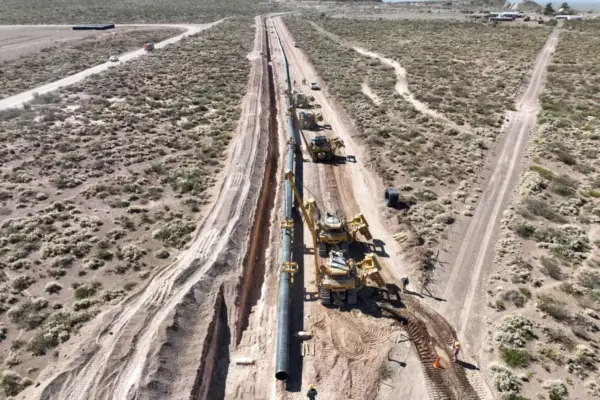
To support this massive outflow of resources, the government is banking on critical infrastructure developments. Milei highlighted the progression of the Vaca Muerta Oil Sur pipeline (VMOS), an estimated US$3 billion initiative designed to drastically expand regional transport capacity and unlock approximately US$15 billion in annual export potential. He also drew attention to the largest private investment project in modern Argentine history: the Argentina LNG initiative. This massive US$51 billion undertaking is spearheaded by state-owned energy company YPF in strategic partnership with Italian energy major Eni and the United Arab Emirates’ XRG.
Milei Defends RIGI and Hits Back at Critics
A central pillar of Milei’s speech was a staunch defense of the Large Investment Incentive Regime (RIGI), a legislative framework enabled by his administration to attract multi-billion-dollar capital commitments. The president claimed the program has successfully drawn more than US$210 billion in publicly announced investment projects, with roughly 45 percent of those funds directly targeting the oil and gas sector.
Describing the program as the most consequential industrial and development policy in the nation’s history, Milei dismissed ongoing criticisms from various economists regarding the potential long-term fiscal costs associated with the regime’s tax and tariff exemptions.
"How can an investment that would never have happened without RIGI have a fiscal cost?" he challenged, addressing skeptics directly.
Milei argued that without the robust security and tax predictability offered by the regime, these capital projects would simply never have materialized. Consequently, they would have generated neither new industrial investments nor future tax revenues for the state. He asserted that the structured incentives have played a vital role in restoring international credibility by legally limiting the federal government’s historic propensity to alter the regulatory rules governing long-term capital investments mid-stream.
"The capital that comes in thanks to RIGI brings projects, jobs, and exports that simply did not exist before, and with them, tax revenue that did not exist either," he emphasized.
Turning his attention to domestic critics of his overarching macroeconomic program, Milei pushed back against assertions that the national exchange rate remains overvalued, noting that such arguments are fundamentally contradicted by the explosive trajectory of the country’s export sectors.
"What kind of overvalued exchange rate is this, in a country where exports are growing five times faster than GDP?" he asked.
The president maintained that true national competitiveness must be driven by structural factors such as lower tax burdens, streamlined regulations, modernized transportation infrastructure, and reduced domestic operating costs, rather than relying on artificial currency devaluations that have historically fueled domestic inflation.
Looking forward, Milei expressed confidence that the broader Argentine economy will naturally converge toward the transparent, investment-friendly framework established by the RIGI. He presented the ongoing energy boom not as an isolated economic anomaly, but as tangible proof that systemic deregulation and a steadfast commitment to market principles can successfully unlock the country’s long-dormant economic potential.