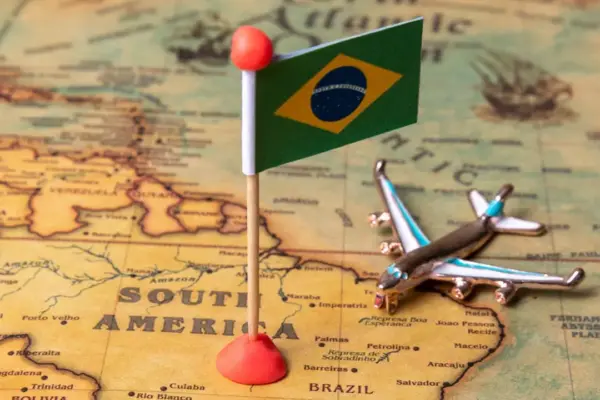











When millions of Brazilians return to the polls on October 25, they will face a consequential choice between two distinct political and economic figures offering sharply contrasting visions for how Latin America’s largest economy should grow, manage its finances, and position itself on the global stage.
The upcoming runoff follows a closely contested opening round of voting that underscored the deep political divisions running through the country. According to official figures released by Brazil’s Superior Electoral Court, Senator Flávio Bolsonaro finished the initial round in first place, capturing 47.03 percent of the valid votes. He was closely followed by incumbent President Luiz Inácio Lula da Silva, who secured 45.16 percent. Because neither candidate crossed the crucial 50 percent threshold required to secure an outright victory, the race immediately advanced to a high-stakes runoff.
For business leaders, institutional investors, and policymakers across the Americas and beyond, the outcome of this election carries profound implications that extend far beyond domestic Brazilian politics. As the region’s economic anchor, Brazil’s trajectory directly influences trade flows, supply chains, energy markets, and investor confidence across the entire Western Hemisphere.
Why Brazil Matters on the Global Stage
To understand why international markets are watching the Brazilian election so closely, one must examine the sheer scale and reach of the country’s economy. Brazil’s gross domestic product reached an estimated $2.28 trillion in 2025, cementing its status as the undisputed heavyweight of the Latin American economy. Furthermore, the country has continued to prove itself as a powerful magnet for international capital, pulling in $77 billion in foreign direct investment that same year—a notable increase from the $63 billion recorded in 2024, according to World Bank figures.
Brazil’s economic architecture is deeply intertwined with the world’s leading economic superpowers. Trade ties stretch outward in multiple directions, creating complex webs of dependency and opportunity. United States trade in goods and services with Brazil totaled an estimated $135.7 billion in 2025, underscoring a robust and enduring bilateral commercial relationship. Simultaneously, trade with Asia has surged, with China accounting for nearly 31 percent of all Brazilian exports during the first eight months of 2026, alongside more than a quarter of the nation’s total imports.
This vast economic scale means that the domestic policy choices made by the next administration will directly impact multinational corporations, logistics providers, energy developers, and manufacturers operating throughout the hemisphere. Whether companies are looking to deploy long-term capital, secure raw materials, or navigate complex regulatory environments, the macroeconomic conditions fostered by the incoming president will dictate corporate strategies for years to come.
Two Different Paths to Growth
At the heart of the October 25 runoff are two fundamentally divergent economic philosophies regarding the role of the state in generating national prosperity. While both candidates promise to deliver growth, investment, and improved public finances, their proposed roadmaps to achieve those goals could not be more different.
President Lula da Silva’s platform largely seeks to build upon the strategic framework of his current administration. His vision relies on an active partnership between private capital and the state, utilizing government influence to guide industrial development, infrastructure expansion, and strategic credit allocation. A central pillar of his program is the strengthening of the Nova Indústria Brasil industrial policy, a state-backed initiative designed to support high-priority sectors and foster domestic technological innovation. Additionally, Lula’s platform calls for the continuation of large-scale infrastructure investments and public-private concessions to modernize the country’s transport and logistics networks.
From a fiscal standpoint, Lula’s economic team has integrated consolidation into its broader developmental strategy. The administration’s roadmap outlines a gradual fiscal adjustment designed to achieve a primary surplus of roughly 1.3 percent of GDP by 2030, all while safeguarding essential social programs designed to protect vulnerable populations.
In stark contrast, Senator Flávio Bolsonaro’s economic platform places a much heavier emphasis on rolling back the footprint of the state and dismantling bureaucratic barriers to private investment. His policy proposals focus on aggressive administrative streamlining, which includes reducing the number of government ministries, cutting public administrative expenditures, and reviving dormant privatization initiatives across state-owned enterprises. Bolsonaro’s platform also promises a comprehensive review of regulatory burdens, sweeping tax cuts, and a broader push toward international trade openness.

Bolsonaro’s economic advisers have advocated for a much faster and more aggressive fiscal adjustment. Their proposals target a fiscal correction equivalent to about 1.5 percent of GDP within an 18-month window, anchored by a newly designed fiscal framework that ties government spending limits much more closely to the nation’s overall debt burden.
Ultimately, the choice facing voters is not a simplistic binary between economic growth and fiscal austerity. Both candidates have made firm commitments to stimulating investment, expanding the economy, and stabilizing public finances. Instead, the real divergence lies in the methodology: one candidate envisions the state as a necessary catalyst and coordinator of development, while the other sees the state as an impediment that must be minimized to allow private enterprise to flourish.
What Business Should Actually Watch Beyond the Campaign Rhetoric
While campaign platforms outline ideological trajectories, corporate leaders must look past the political rhetoric to examine the systemic realities that will constrain whoever takes office.
Macroeconomic conditions present immediate hurdles. Brazil’s central bank has maintained its benchmark Selic rate at a lofty 13.75 percent to combat inflationary pressures. Meanwhile, the International Monetary Fund has repeatedly emphasized that a significantly more ambitious fiscal effort will be required to place the nation’s public debt on a firmly downward trajectory, a prerequisite for creating the conditions necessary for lower borrowing costs and sustained credit expansion.
A major challenge for the incoming administration will be the practical execution of its fiscal promises. Neither campaign has yet detailed the politically painful and complex measures that would be required to meet their stated fiscal targets, particularly given that mandatory government expenditures leave very little room for budgetary maneuver.
Furthermore, the next president will immediately inherit the immense challenge of implementing Brazil’s sweeping consumption-tax overhaul. Because key components of this historic tax transition are scheduled to take effect beginning in 2027, businesses will be forced to navigate a period of profound regulatory and structural change from the very opening days of the new administration.
Legislative realities will also dictate the pace and scope of reform. Bolsonaro’s Liberal Party emerged from the October legislative elections with a substantially strengthened presence in Brazil’s national congress. This shift ensures that the legislature will act as an independent and powerful arbiter, holding immense influence over how much of either candidate’s ambitious economic agenda can successfully transition from campaign promises into binding national policy.
The Bottom Line for the Region
The presidential runoff presents businesses and international observers with two distinct theories of economic development. One relies heavily on the guiding hand of the state to mobilize investment, protect strategic industries, and drive industrial modernization. The other champions a smaller government, fewer administrative barriers, and an unfettered reliance on private capital to generate wealth.
Yet, regardless of which candidate prevails on October 25, the winner will inherit the exact same structural constraints and economic headwinds: elevated borrowing costs, intense fiscal pressure, a massive tax system overhaul, and a powerful, assertive congress capable of blocking or reshaping executive initiatives.
For executives, investors, and analysts closely monitoring developments in Brazil, the most critical question in the wake of the election may not be which ideological vision wins the popular vote. The true test will be determining how much of that vision can realistically be translated into governance in a complex democracy.