










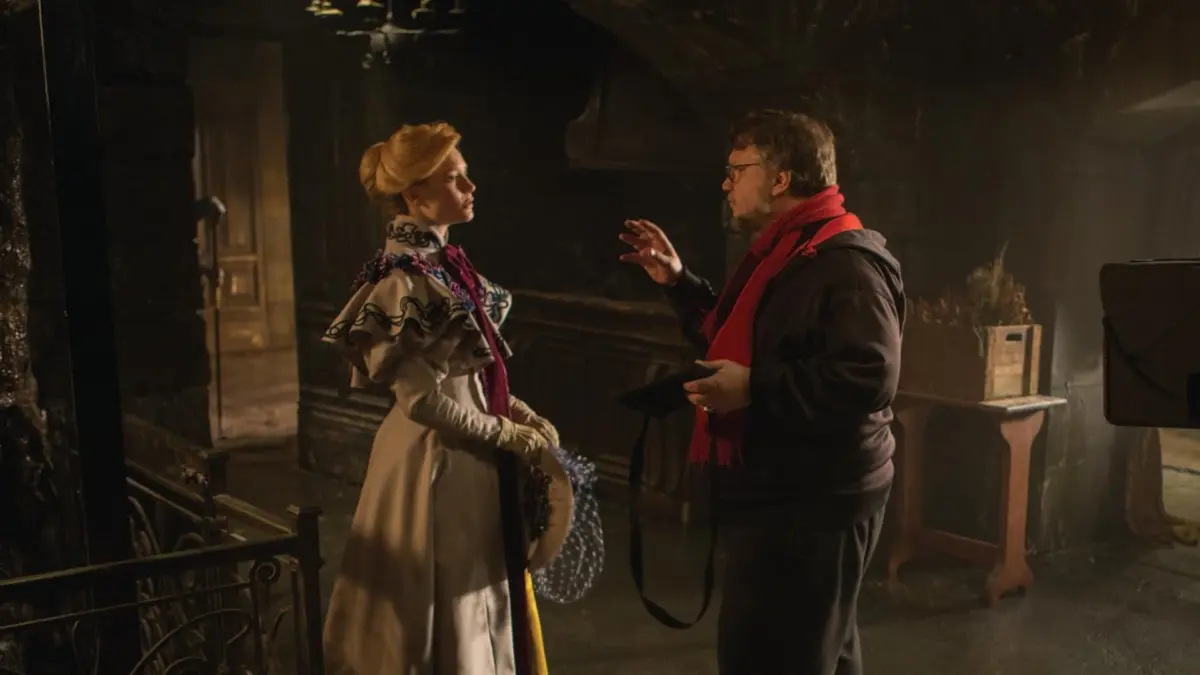
As a young child mourning the loss of her beloved grandmother, she recalled hearing the unmistakable, quiet rustle of a silk dress echoing down a corridor, smelling the familiar and comforting scent of her grandmother’s perfume, and finally feeling a sudden, heavy weight settle against her back. Decades later, that deeply personal and unsettling childhood memory inspired the haunting, atmospheric opening of her son’s lavish 2015 gothic romance film.
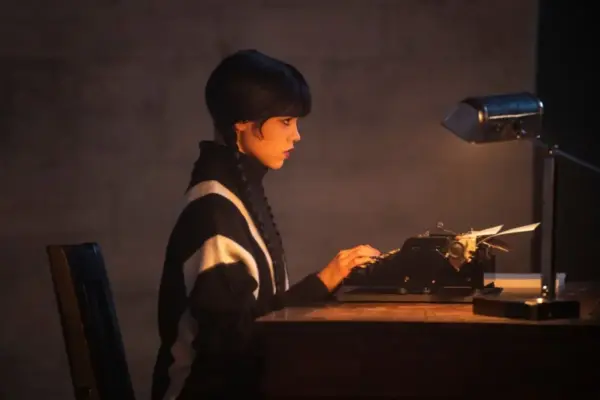
Del Toro’s Crimson Peak follows Edith Cushing, played by Mia Wasikowska, an aspiring young author in turn-of-the-century New York who falls deeply in love with Sir Thomas Sharpe, a mysterious and charismatic British aristocrat portrayed by Tom Hiddleston. After a whirlwind romance and marriage, Edith moves across the Atlantic to live with Thomas and his enigmatic sister, Lady Lucille Sharpe (played by Jessica Chastain), in Allerdale Hall—a sprawling, decaying gothic mansion sinking ominously into a remote, red-clay English countryside. Once inside the cavernous estate, Edith quickly discovers its deeply sinister secrets, the tragic history of the Sharpe family, and the terrifying, bleeding ghosts that inhabit its very walls, watching her every move.
While the film has steadily cultivated a passionate cult following among horror fans and cinephiles alike for its intoxicating gothic atmosphere, intricate production design, and shocking narrative twists, its most memorable opening sequence draws heavily on a story much closer to home. In 2015, while promoting the film’s theatrical release, del Toro opened up to Cinemablend about the true-life origins of the movie’s spectral manifestations. He recounted the personal family anecdote that kickstarted the horror on screen, explaining how his mother’s childhood grief manifested into something truly supernatural.
Del Toro shared the chilling account during his press rounds, explaining, "My mother’s grandmother died, and when she was a child she was crying in her bed, and she heard the silk of the dress of her grandmother move in the corridor. She smelt her perfume, heard the bed springs creak, and felt the weight of her grandmother leaning on her back. She jumped up screaming and left the room."
This intimate family story fits neatly into a broader, deeply personal well of inspiration that has fueled the director’s career for decades. Raised in Guadalajara, Mexico, del Toro has long drawn heavily on Mexican culture’s rich relationship with spooky folklore, Catholic iconography, magical realism, and spirituality. His unique cinematic perspective often blends historical trauma with dark fantasy, exploring how human monsters and actual supernatural entities frequently mirror one another.
Throughout his illustrious career, with critically acclaimed and visually arresting films such as Crimson Peak, Pan’s Labyrinth, The Devil’s Backbone, and his ambitious adaptations and original projects, including his take on Frankenstein, he has firmly established himself as one of Mexico’s most influential and visionary filmmakers working in the horror, fantasy, and science fiction genres. His distinct artistic voice bridges traditional Hollywood storytelling with a distinctly Latin American sensibility toward the afterlife and the unknown.
At a 2015 press conference held in New York City to discuss the release of Crimson Peak, del Toro elaborated on this cultural perspective, noting that his specific way of viewing "monsters or ghosts is very Latin." In Mexican folklore and spiritual traditions, ghosts and spirits are rarely portrayed as purely malicious Hollywood tropes designed solely for cheap jumpscares; instead, they often represent unfinished business, profound sorrow, ancestral memory, or the lingering weight of grief that the living carry with them long after a loved one has passed away. This philosophical approach to the spectral realm is precisely what allowed his mother’s frightening childhood encounter—rooted deeply in the innocent sorrow of losing a grandmother—to be translated into an evocative cinematic moment characterized not just by terror, but by melancholic beauty and emotional resonance.
As audiences revisit Crimson Peak, they do so with his mother’s intimate story lingering in the background. It serves as a striking reminder that even in a Hollywood production filled with elaborate digital effects, painstaking set design, and gothic extravagance, one of Guillermo del Toro’s most haunting and visceral cinematic scenes ultimately began at home, rooted in a young girl’s genuine account of grief, memory, and a ghostly encounter in a dark hallway.