









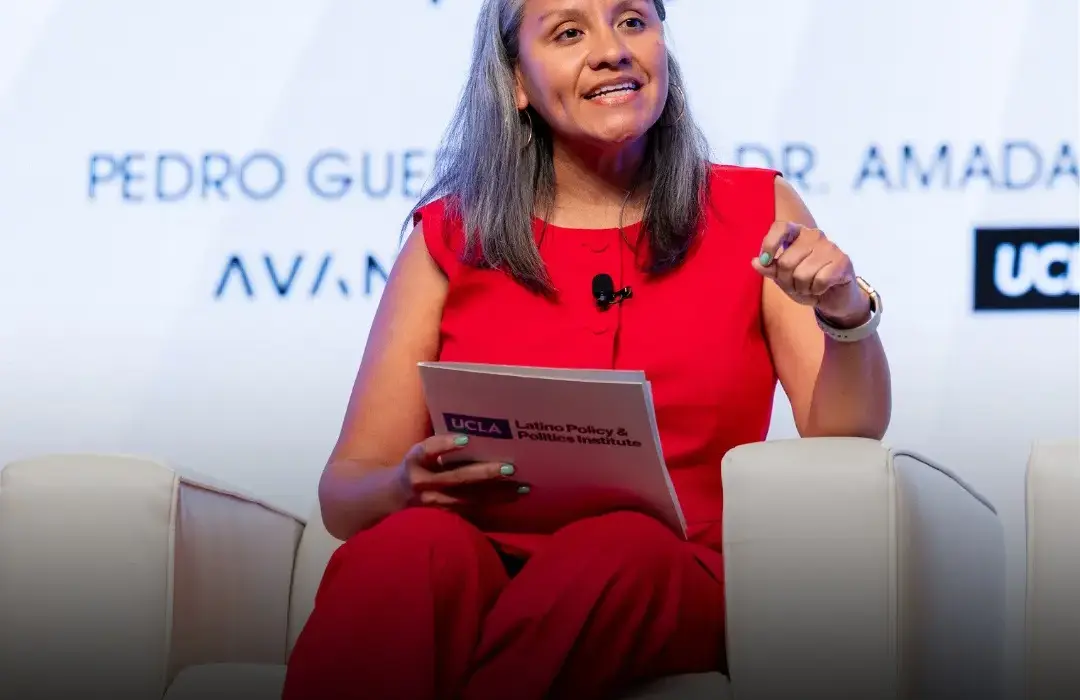
LAS VEGAS — For scholars, researchers, and community advocates working at the intersection of public policy and marginalized communities, the challenge has rarely been a lack of data. In an information-rich era, statistics, demographic studies, and policy analyses are more abundant than ever. Yet, according to Dr. Amada Armenta, an associate professor at the University of California, Los Angeles (UCLA) and faculty director of the UCLA Latino Policy and Politics Institute (LPPI), the mere existence of data is never enough to drive meaningful change.
Speaking to attendees at the 2026 AVANCE Global conference, held at the Bellagio in Las Vegas, Armenta delivered a compelling message about the vital role of research translation, community representation, and storytelling in modern advocacy. Her landmark 2017 book, Protect, Serve, and Deport: The Rise of Policing as Immigration Enforcement, provided a timely scholarly lens on immigration and law enforcement when it was first published. Nearly a decade later, as immigration policy and systemic enforcement remain central flashpoints in American society, her insights are even more urgent.
Armenta’s perspective carries distinct weight, rooted in both academic rigor and lived experience. Historically, she points out, research concerning Latino communities has frequently been conducted by outsiders—scholars and institutions with significant social distance from the populations they study. In contrast, researchers like Armenta bring an insider’s perspective, pairing rigorous academic methodology with a deep personal passion for telling accurate, resonant stories about their own communities.
This approach shifts the ultimate goal of scholarship. For Armenta and her colleagues at the LPPI, research is not pursued solely for academic advancement or publication in peer-reviewed journals. Instead, it serves as a crucial bridge between distinct worlds.
"We also do research that is meant not just for academic advancement, but to bridge worlds," Armenta told conference attendees. "We share research with policymakers, nonprofit organizations, or community-based organizations that want to use it for advocacy, and business communities that may not have time to read academic studies. We do research translation that really illustrates why data is so important."
This commitment to accessible communication stems from a lifelong fascination with public affairs. As a young person, Armenta was an avid political junkie who eagerly canvassed for campaigns and declared to those around her that she intended to become president of the United States. However, an internship in Washington, DC, during her youth quickly shifted her perspective. She realized that partisan politics was not the lens through which she wanted to view or shape the world. Rather than holding elected office, she wanted to be the trusted expert that political leaders, policymakers, and community organizers turned to for help understanding complex, multifaceted social issues.
That ambition paved the way for a distinguished career in sociology and policy research, defined by a hallmark trait that colleagues and audiences alike have come to recognize: directness. In academic and policy circles, where discussions can often become mired in dense jargon and qualifiers, Armenta’s straightforward communication style stands out. No one leaves a conversation with her confused about her meaning or uncertain of her stance.
"I think I’m really direct," Armenta reflects. "It’s unusual for researchers to be able to distill information in an understandable way, and it’s something I feel really passionate about."
That clarity is especially vital at a gathering like the AVANCE Global conference, which centers heavily on themes of economic empowerment, representation, and unity. Within such spaces, it is imperative to hear directly from scholars examining systemic issues—such as immigration enforcement—that disproportionately and negatively impact Latino families and communities across the United States. According to Armenta, the modern world is in profound need of reputable, evidence-based information produced by smart, passionate individuals who understand how to communicate beyond the ivory tower.
The core of her philosophy rests on a fundamental principle of modern advocacy: numbers and charts cannot carry a message on their own.
"Because data doesn’t speak for itself," the researcher emphasizes, "we need to help craft the story to make our data have power."
Translating complex empirical findings into accessible, persuasive narratives requires immense time, energy, and emotional labor. Currently, Armenta finds herself stretched thin across multiple professional commitments, balancing high-profile speaking engagements, ongoing research projects, and her responsibilities as an educator and institute director at UCLA. This heavy workload has forced her to carefully weigh whether she is ready to commit the substantial time required to write a follow-up book to her pioneering 2017 work.
As she evaluates her next major writing project, Armenta is considering whether the same critical information might be distributed through alternative, more digestible mediums while still honoring the deep commitment to storytelling that defines her career. She believes that innovative formats are possible, but finding the bandwidth to plan and execute them remains a challenge amid her demanding schedule of teaching, researching, and public engagement.
For now, her presence at the AVANCE Global conference underscores the enduring power of academic research when it is paired with clear communication and a genuine dedication to community advocacy. As leaders, entrepreneurs, and policymakers grapple with the complex economic and social realities shaping the future of the nation, voices like Dr. Amada Armenta continue to provide the vital context needed to transform raw data into meaningful change.