








By María Constanza Costa
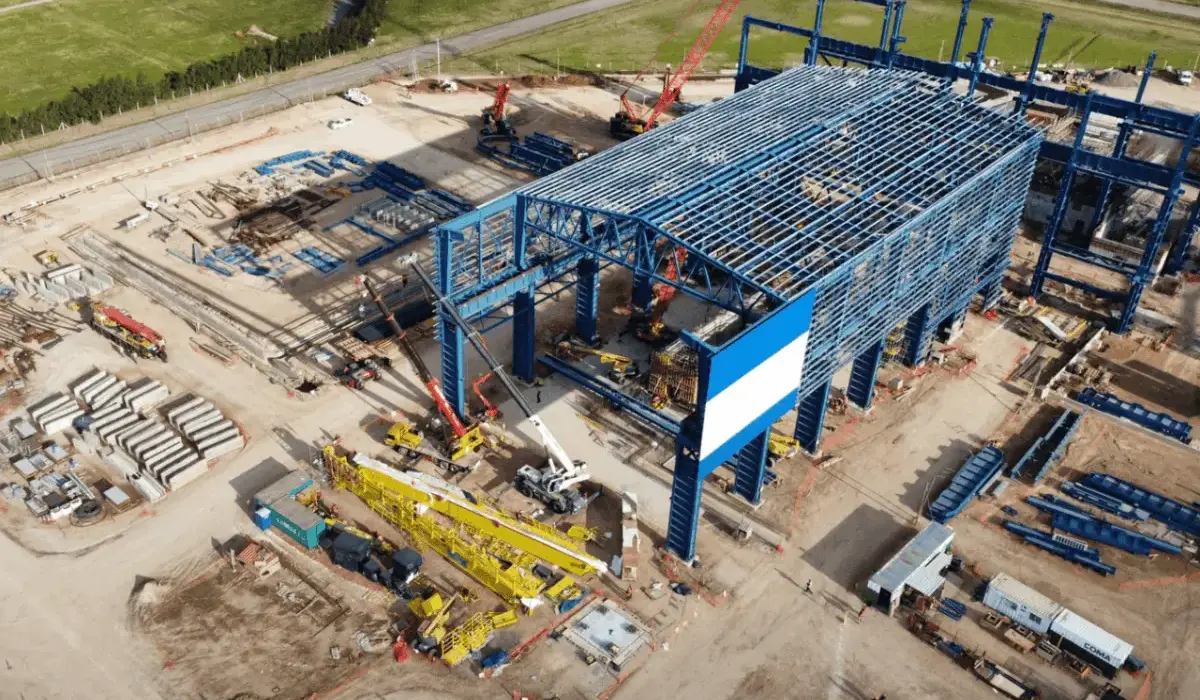
San Nicolás de los Arroyos in northeast Argentina is a riverside town with decades of steelmaking tradition. Today, the steady, heavy rumble of machinery emanating from a 15-hectare site marks the sound of its next industrial era taking shape.
A new, US$300 million steelworks is currently under construction in the region, a facility boasting the potential to manufacture 360,000 tonnes of lower-emissions steel annually. In nearby workshops, its first wave of operators is already undergoing specialized training to run both an advanced electric arc furnace and the recycled scrap processing systems that will eventually feed it.
When commercial operations officially begin in late 2027 or early 2028, the plant will represent the very first steelmaking manufacturing facility for Sidersa. Until now, the Argentine company has specialized primarily in the marketing and commercial distribution of steel products rather than primary production.
Sidersa has pledged to create more than 300 direct jobs and roughly 3,500 indirect jobs in a community whose history has long been inextricably linked to the industrial soot and towering chimneys of traditional steel production. Yet these ambitious expansion plans, partially funded through the local subsidiary of a major Chinese state bank, are designed around a much lower carbon footprint. Sidersa routinely describes the forthcoming plant as a physical symbol of the "green" steel that "the world will want" and that Argentina is uniquely positioned to offer.
Given that the global steel sector accounts for roughly 7% to 9% of total global carbon dioxide emissions, an urgent transition toward greener manufacturing processes has become a paramount imperative for both the industry and international policymakers. Producing steel from recycled scrap metal using electric arc furnaces—the method Sidersa plans to employ—typically reduces greenhouse gas emissions by around 70% on average when compared to conventional blast furnace steelmaking, which relies on virgin iron ore melted in coal-fired furnaces.
While electric arc technology is not entirely new to Argentina, what sets this particular project apart is the sheer scale of the investment and the complex political and regulatory context in which it is unfolding. However, environmental experts emphasize that just how "green" this steel ultimately turns out to be will depend heavily on two critical variables: the carbon intensity of the electricity grid powering the plant, and the environmental sustainability of the scrap metal supply chain.
Cleaner steel needs greener grid and scrap supplies
The manufacturing process chosen for Sidersa’s San Nicolás plant deliberately bypasses the coal-hungry, emissions-intensive blast furnace stage. According to data compiled by the Inter-American Development Bank (IDB), electric arc furnaces already accounted for approximately 57% of total steel production in Argentina in 2023.
However, simply utilizing an electric furnace does not automatically guarantee environmentally friendly steel production. First and foremost, an electric arc furnace is only as clean as the electrical grid that powers it.
Initially, the new steelworks will be supplied directly by Argentina’s national interconnected power grid, which is currently dominated by gas-fired thermal power stations. While Sidersa has indicated that it is actively considering the possibility of powering the facility directly from dedicated renewable energy sources in the future, the immediate reality of the nation’s energy infrastructure presents significant bottlenecks.
During 2025, variable renewable energy sources such as wind, solar, small-scale hydropower, biomass, and biogas met 18.9% of Argentina’s overall electricity demand. When large hydroelectric installations are factored into the equation, that figure exceeds 40%.
Despite these figures, the country’s high-voltage transmission grid is operating at absolute capacity. "The electricity grid in Argentina has been saturated for over a decade," Adrián Sergenty, an engineer and political scientist specializing in energy policy, told Dialogue Earth. "The company will have to decide whether to build its own facilities or partner with a nearby renewable energy generator that can guarantee its supply directly."
Beyond electricity, the project faces questions regarding its basic raw material: scrap metal. The global scrap metal market has increasingly encountered growing shortages and restrictive export controls. "Our surveys show there is sufficient availability on the domestic market to supply us 100% with domestic scrap metal," Alejandro Galdeano, steelworks manager at Sidersa, told Dialogue Earth.
Nevertheless, scrap metal collection logistics across Latin America heavily involve informal networks that pose distinct environmental and social challenges. These include practices such as the open-air burning of insulated electrical cables to recover copper, alongside the uncontrolled disposal of non-valuable waste materials.
In response, Sidersa maintains it is drawing up a comprehensive supply plan that accounts for both large-scale commercial suppliers and structured collaborations with various municipal authorities across the country. The company aims to establish regulated collection points for scrap metals that simultaneously enable local communities to clear industrial and domestic waste from their surrounding environments.
A steel industry expert consulted by Dialogue Earth, who requested anonymity, explained that the project’s long-term commercial viability depends not only on the chosen technology or access to renewable energy, but equally on the broader economic and commercial context. The specialist noted that the plant will only realistically reach its projected production capacity if there is sustained, robust demand within the domestic market.

The specialist added that achieving the scale of production estimated by Sidersa would require "some sort of miracle," arguing that it would likely necessitate either extraordinary growth in local steel consumption or a significant loss of market share by established international and domestic competitors, such as Acindar, Sipar Acero, or Acerbrás.
If Sidersa can successfully produce lower-emissions steel at scale, it could secure a crucial competitive advantage in exporting to foreign jurisdictions with stringent environmental standards, such as the European Union. Since the beginning of the year, the European Union’s landmark Carbon Border Adjustment Mechanism has applied directly to iron and steel imports, effectively linking their import costs to the embedded carbon emissions of those products. For the time being, however, Sidersa’s production is focused almost entirely on serving the domestic market.
Environmental concerns
The local community in San Nicolás has valid historical reasons to approach grand promises from heavy industry with caution. The city is already home to the massive, historic General Savio steelworks complex, operated by Ternium Argentina. That existing facility has faced ongoing legal challenges concerning its industrial waste management and effluent controls.
In 2023, an independent expert report commissioned as part of an environmental injunction highlighted a notable lack of proper permits for the discharge of industrial liquid effluents, alongside the troubling presence of heavy metals detected in local groundwater supplies.
Sidersa has also found itself embroiled in a separate environmental dispute regarding the ongoing construction of its own plant. The local non-governmental organization United for Life and the Environment (UPVA) has accused the steelmaker of causing "enormous environmental damage" by allegedly extracting tosca—a local sedimentary material used to level ground and lay foundations for industrial sites—from an unauthorized quarry near the Ramallo stream without proper provincial or municipal clearance.
While local courts have officially opened both civil and criminal investigations into the matter, construction work on the site continues unabated.
Sidersa maintains that the allegations stem entirely from a third-party supplier, which asserts that the rubble in question was extracted from quarries duly authorized by the provincial authorities of Buenos Aires and San Nicolás. The company asserts that the extraction was carried out strictly within legal boundaries and with all necessary authorizations, as explicitly stipulated in their commercial contracts.
"We regret the lawsuit that has been filed, to which we are responding through the appropriate legal channels," Lucrecia Payer, Sidersa’s director of institutional relations, told Dialogue Earth.
Chinese funding and the RIGI initiative
Sidersa’s journey toward securing project financing involved several twists. The company initially sought institutional backing from the private-sector arm of the Inter-American Development Bank, IDB Invest, as well as the International Finance Corporation, a member of the World Bank Group. However, those preliminary financing agreements eventually fell through.
Ultimately, the company chose to finance two-thirds of the total investment out of its own pocket, significantly shrinking the proportion of external debt required. To cover the remaining balance, Sidersa secured a US$100 million loan facilitated through ICBC Argentina. As the local subsidiary of the Chinese state-owned Industrial and Commercial Bank of China, the institution is directly facilitating the purchase of imported heavy machinery required for the new plant.
Significantly, the San Nicolás plant has become the very first industrial manufacturing project to officially benefit from Argentina’s newly established Large Investment Incentive Regime, widely known by its Spanish initials as RIGI.
The legislation, approved in 2024, is designed to attract large-scale foreign and domestic capital by offering substantial tax incentives, customs exemptions, and ironclad guarantees of long-term regulatory stability spanning up to 30 years. For the federal government, the regime is championed as a vital instrument for providing predictability to investors operating within a country where historically turbulent macroeconomic conditions have frequently made long-term financial certainty difficult to secure.
However, the regime has drawn sharp criticism from economic think-tanks, such as Fundar, which argue that the framework grants sweeping fiscal benefits to major corporations without demanding strict, enforceable conditions in return—particularly regarding environmental safeguards and local supply development.
"Each concession could be linked to a specific objective, and if that objective is not met, the concession should be withdrawn," said Guido Zack, Fundar’s director of economics. "This is how it is done in other countries such as Chile, Brazil, or Norway; such schemes only work when the public sector, as well as granting benefits, demands clear commitments regarding the development of local suppliers, production targets and employment […] and, in the current climate, also in renewable energy."
By September, construction work on the Sidersa project had reached 27% completion, with company executives anticipating that the very first batches of commercial steel will roll off the line in the first half of 2028.
The long-term outlook remains ambitious. Whether Sidersa will successfully manage to source its raw materials almost entirely from domestic scrap, whether it can secure adequate low-emission electricity on the Argentine market, and whether the financial advantages provided by the RIGI program will prove sufficient to make lower-carbon steelmaking economically competitive will become clear as construction nears its finish.